Primal Supply Meats keeps farmers working and locals fed during Covid-19
Foodizen: Revolutionizing Your Meat
While national suppliers come upwardly short during the pandemic, Philly'due south Central Supply Meats is keeping fridges stocked and local farmers adrift. That'south proficient for our diets—and our economy
Jun. 17, 2020


Every bit the atmospheric condition warms and social distancing remains the law-of-the-land, Philadelphians are probable to enjoy summer 1 of the only ways they can: backyard barbecues.
But things don't await practiced for the national meat market. Thank you to disturbing numbers of coronavirus cases among its employees, the country's major meat processors—including Tyson Foods, WH Group's Smithfield Foods and JBS Us—temporarily closed about twenty slaughterhouses last month.
That's meant a major national shortage in meat products—and steadily climbing prices on grill-ready burgers, hot dogs and chicken at your neighborhood grocery store.
 But while the corporations that dominate our centralized food system are scrambling to adapt to the Covid-xix crisis, local suppliers are standing strong. Philly's own Primal Supply Meats has plenty of fresh pork and poultry on mitt, with options for home delivery and condom, contactless pick-up.
Then why is Primal Supply thriving in the wake of coronavirus restrictions, while bigger and older companies are crippled? Owner and head butcher Heather Thomason says that the small and contained nature of Central Supply—and the dozen or so regional farms and slaughterhouses information technology works with—is its biggest forcefulness.
Thomason founded Primal Supply in 2022 as a wholesale and subscription operation, before opening ii brick-and-mortar locations in South Philly and Brewerytown. She made a proper noun for herself selling locally sourced whole animals to restaurants around the urban center, revolutionizing Philadelphia'due south meat supply bondage.
To Thomason, local has always been the name of the game. She created Cardinal Supply as a means to support regional farmers—from Wild Rose Ranch in PA to Roaming Acres Farm in NJ—whose agriculture practices are far more than sustainable and ethical than the mass product that'south come to characterize manufacturing plant farms.
"The commodity meat industry, the ways in which they heighten and process animals are very different from what we do," Thomason says. "We work with small farmers that are all committed to pasture-based systems. Then they're raising animals on state with space. They're good for you. They're not concentrated."
"In that location'southward and so much doubt for people right now, about access and sourcing and where their nutrient is coming from," Thomason says. "People are opening their optics to the fact that what they're used to and what they took for granted isn't working anymore. It'due south really shed a calorie-free on the merits and sustainability of local food."
Thomason's partner farms also refrain from injecting hormones or sub-therapeutic antibiotics in their animals, and make use of regenerative farming practices that build food-rich topsoil that is less susceptible to drought and can describe down carbon from the atmosphere.
Those practices—combined with the fact that transportation between suppliers and processors is minimal—means Primal Supply'due south local supply chain is much less taxing on the environment than Tyson'south massive operation. Of course, ethical growing practices are more time- and labor-intensive, so sustainable meat is pricier meat. Cardinal Supply'southward beefiness bone-in strip steak, for instance, comes to $24.99 per pound.
But those dollars are likely to come dorsum around to you. Buying from Central Supply means supporting family-owned farms inside the region, rather than sending your dollars to the executives at Tyson'south Arkansas headquarters. Studies show that supporting modest, local businesses and purveyors is linked to higher income growth, lower levels of poverty and a stronger middle class in surrounding communities.
That's likely because those employers oft pay higher wages and provide amend benefits than large-box stores. Plus, shopping locally helps to build a stable local economy that'll go along wealth circulating in the community—something much-needed at present, in the face of an unprecedented economic crisis.
A small just mighty ecosystem …
Cardinal Supply isn't alone. Pocket-size markets and grocers around the city—like Riverwards Produce, Rowhouse Grocery, Mariposa Food Co-op, Tela'due south Marketplace and Kitchen and more—all source their products from local growers. And they've all plant ways to adjust, whether through dwelling delivery or express in-store hours, while keeping their fresh products rolling in.
When Covid-xix swept the land, bringing shutdowns and strict safe guidelines with it, Primal Supply'south small merely mighty ecosystem allowed the butchery to quickly pin and survive—while larger meat processors are faltering.
Thomason says her supply of whole animals hasn't slowed, since the farmers and slaughterhouses she works with have been able to infinite out their staff and quickly establish sanitation protocols.
"The number of employees they have, and the space that they work in is not crowded, it'due south not dense, it'due south not a factory that's focused on higher speed, highest volume of processing for profit," Thomason says. "Nosotros telephone call each other on the phone, we check in, we run across how everybody'southward doing. Everyone has been able to be resilient in the sense that nosotros can shift and change and adjust to keep people safe, and the large industrial arrangement doesn't have the ability to do that."
Thomason's own staff of xx has also had to adapt. In March, afterwards Philadelphia's  restaurants were shuttered due to the citywide shutdown, Fundamental Supply lost its entire wholesale arm—representing 45 percent of its acquirement—overnight. Just just when Thomason began to panic, customers old and new showed up to the butcher store in droves to stock up their freezers.
"Meat that we would have sold to restaurants, we were able to make bachelor to home cooks," Thomason says. "Considering nosotros're butchers. We tin can modify the way that things are cutting or portioned or sold."
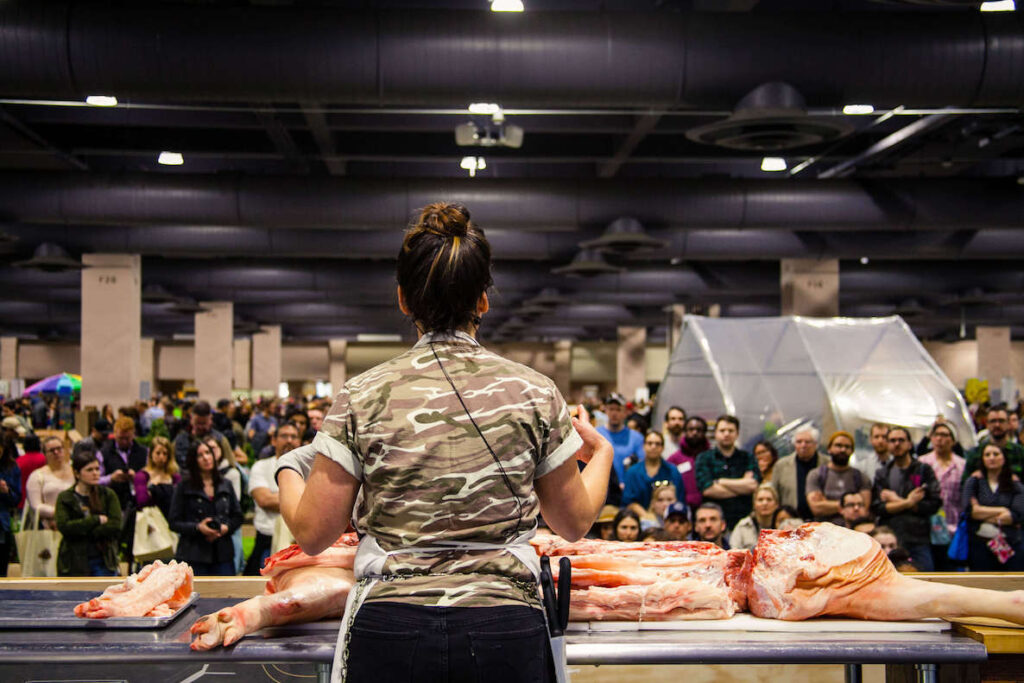
"Nosotros're not going back, we're going forward."
Retail sales have shot up, effectively balancing out the loss in revenue from Central Supply's eating house accounts. But rather than institute painstaking safety measures to suit those customers in-person—from plexiglass screens to in-shop capacity limits—Thomason decided to shut the store to walk-in business organisation and shift her operation entirely online.
Primal Supply's site now includes a virtual shop, assuasive customers to place orders for pickup or home delivery. The butchery had been toying with an online sales platform for a while, but ramped upwardly those efforts to plough out the terminal production in a matter of weeks.
The abode commitment option is a brand new addition to Key Supply'southward business model, but it's been working smoothly, co-ordinate to Thomason. (Primal Supply'due south popular pay-as-you-go subscription meat program—dubbed The Butcher's Club—is nonetheless option-up only.)
"The commodity meat industry, the ways in which they raise and procedure animals are very different from what we do," Thomason says. "We work with small farmers that are all committed to pasture-based systems. So they're raising animals on land with space. They're good for you. They're non full-bodied."
To make the switch successful, Thomason's staff has had to have on new roles and drastically shake-upward their day-to-mean solar day routines. People in charge of customer service in-person are now answering emails, and people who worked the counter now pack and sell groceries.
But as stressful as the pivot has been, Thomason is grateful it's allowed her to retain her employees. Thomason says that the small nature of her staff is exactly what immune the operation to adjust. And that fits with studies that testify that pocket-sized businesses retain, and even create, far more jobs during economic downturns than large corporations do.
 "This is a really difficult time for people to work and live through, only they're and then proud of the piece of work that we're doing right now," Thomason says of her staff. "We've settled into new roles and after a really stressful period, people are skillful at their jobs again and know what to do at work and that feels bully."
Thomason says that Primal Supply will maintain its new online system, even after customers can safely shop at the walk-in locations. The mail-pandemic business model is shaping up to exist a hybrid between online and in-person retail.
"Nosotros've inverse. And I think for the better, honestly," Thomason says. "I've been training myself not to utilise the word 'render.' Because we're not going back, nosotros're going forrad."
A boost in non-meat items
Part of that change includes a boost in not-meat items up for offering on Central Supply's site. The butchery has always sold a small-scale option of produce and prepared food from its partner farmers and Philly-based purveyors, similar Lancaster Farm Fresh and Mycopolitan.
And since those businesses also saw their wholesale accounts vanish in the wake of the citywide shutdown, Thomason decided to use the capacity one time reserved for restaurants to instead abound its supply of locally sourced fruits and veggies.
"I started talking to all of [the purveyors] and proverb, 'Nosotros can keep selling your stuff and maybe we tin sell a little more because folks are having a hard time going to the grocery store now,'" Thomason says. "My relationships are deepening with these local purveyors and it's a lot of fun to watch the local produce curlicue in and source beautiful things that are coming into flavor and see our customers exist excited."
Thomason hopes that all this change is for the better, particularly when it comes to awareness most how and where we buy our food. As minor, local businesses like Cardinal Supply stand stiff through this crisis, people may finally start to capeesh them.
"There'south and then much dubiety for people correct now, nigh access and sourcing and where their food is coming from," Thomason says. "People are opening their eyes to the fact that what they're used to and what they took for granted isn't working anymore. It's really shed a low-cal on the merits and sustainability of local food."
Keith Wadel of Wild Rose Ranch in Dry Run, PA. Photo by James Collier 
blumenthaladelthe.blogspot.com
Source: https://thephiladelphiacitizen.org/primal-supply-meats/
0 Response to "Primal Supply Meats keeps farmers working and locals fed during Covid-19"
Post a Comment